
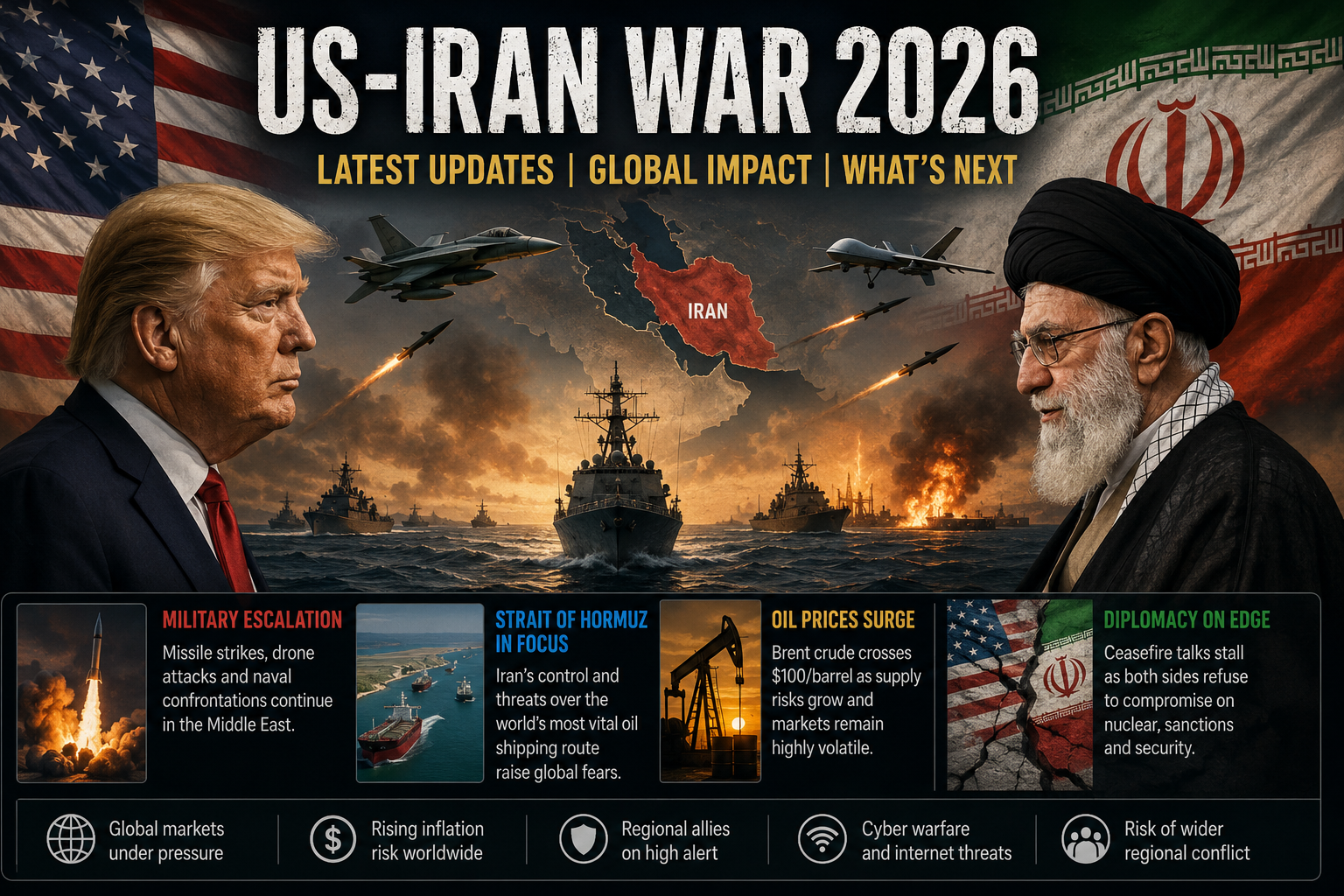
The Middle East is once again at the center of a global geopolitical crisis. The ongoing conflict between the US and Iran has now entered one of its most dangerous phases in decades. What started as military escalation earlier this year has transformed into a wider regional confrontation involving naval blockades, missile strikes, proxy warfare, cyber disruptions, and an unprecedented standoff in the Strait of Hormuz.
As of May 2026, the world is watching closely because this is no longer just a US-Iran issue. The conflict is now affecting global oil prices, shipping routes, internet infrastructure, stock markets, and diplomatic alliances across Asia, Europe, and the Gulf region.
With ceasefire talks hanging by a thread and military deployments increasing on both sides, fears of a wider regional war are growing rapidly.
What Triggered The Latest US Iran Conflict?
The roots of the current conflict go back several years.
Tensions between the United States and Iran have existed since the 1979 Iranian Revolution. But the latest escalation intensified dramatically after a series of American and Israeli military operations targeting Iranian nuclear and military infrastructure earlier in 2026.
According to multiple reports, the February 2026 air campaign carried out by the US and Israel targeted strategic Iranian facilities, missile systems, and Revolutionary Guard infrastructure.
Iran responded aggressively.
Tehran launched missile and drone attacks targeting:
- US military assets
- Israeli infrastructure
- Gulf-region installations
- Commercial maritime routes
Soon after, the Strait of Hormuz became the biggest battlefield in the crisis.
Why The Strait Of Hormuz Matters So Much
The Strait of Hormuz is one of the most important shipping routes in the world.
Nearly 20–25% of global oil trade passes through this narrow waterway connecting the Persian Gulf to the Arabian Sea. Countries like Saudi Arabia, Iraq, UAE, Kuwait, and Qatar depend heavily on this route for energy exports.
When Iran began restricting movement through the strait, the entire world economy started feeling the pressure.
Iran reportedly:
- Warned foreign ships against entering the region
- Intercepted or attacked commercial vessels
- Deployed sea mines
- Used drones against maritime targets
- Imposed selective restrictions on shipping traffic
As a result:
- Tanker movement collapsed
- Hundreds of ships were stranded
- Insurance costs skyrocketed
- Oil prices surged globally
Reuters recently reported that only limited tanker movement has resumed and that Iran is effectively controlling who gets passage through the route.
This has created what analysts call a “new abnormal” in global shipping.
Latest Updates In The US Iran Conflict (May 2026)
Trump Rejects Iran’s Proposal
The biggest recent development came when US President Donald Trump rejected Iran’s latest peace proposal.
Trump reportedly called Tehran’s response “totally unacceptable” and warned that the current ceasefire is on “massive life support.”
Iran’s counteroffer reportedly demanded:
- Removal of US sanctions
- End of naval restrictions
- Resumption of Iranian oil exports
- Compensation for war damages
- Security guarantees
Washington, however, continues demanding:
- Major restrictions on Iran’s nuclear program
- Reduced uranium enrichment
- Stronger military commitments
- Freedom of navigation in Hormuz
The disagreement has effectively stalled negotiations.
Iran Warns It Is Ready For “Any Aggression”
Iranian officials have significantly increased their rhetoric over the past few days.
Iran’s parliamentary speaker Mohammad Bagher Ghalibaf warned that Tehran is prepared to respond to any aggression from the United States.
Meanwhile, Iranian lawmakers have even threatened “weapons-grade” uranium enrichment if Iran faces another major attack.
That statement has alarmed Western governments because enrichment levels near 90% are considered close to weapons-grade capability.
The Nuclear Issue Remains The Core Problem
At the heart of the conflict lies Iran’s nuclear program.
The US and its allies believe Iran could eventually develop nuclear weapons if enrichment activities continue unchecked.
Iran insists its nuclear program is peaceful and meant for civilian energy purposes.
However, Washington wants:
- Strict inspections
- Reduced enrichment
- Limits on advanced centrifuges
- Long-term monitoring
Tehran views many of these demands as unacceptable interference in national sovereignty.
This disagreement has blocked meaningful diplomatic progress for years.
US Military Build-Up Is Expanding
Another reason global tensions are rising is the visible American military expansion in the region.
Recent developments include:
- Increased US naval presence in the Gulf
- Strategic bomber deployments
- Missile defense activation
- Expanded surveillance operations
- Public disclosure of nuclear-capable submarine positioning
Analysts believe these moves are meant to pressure Iran psychologically while also reassuring Gulf allies.
The Pentagon’s unusual public reveal of an Ohio-class submarine location near Gibraltar has been interpreted as a major strategic signal.
At the same time, Iran has increased:
- Missile readiness
- Drone deployments
- Revolutionary Guard naval patrols
- Proxy coordination across the region
The military posturing on both sides has significantly increased the risk of accidental escalation.
Oil Prices Are Rising Again
The biggest global economic impact of the war is being seen in energy markets.
Brent crude prices have crossed the $100-per-barrel mark again amid fears that Hormuz may remain partially blocked for months.
Saudi Aramco’s CEO recently warned that oil markets may not stabilize this year if the conflict continues.
Why this matters:
- Fuel prices increase globally
- Inflation rises
- Transport costs increase
- Air travel becomes expensive
- Manufacturing slows down
- Food prices may rise indirectly
Countries like India, China, Japan, and South Korea are particularly vulnerable because they import large quantities of Middle Eastern energy.
Impact On India
India is closely monitoring the situation because the Middle East is critical for:
- Oil imports
- Trade routes
- Indian expatriate workers
- Regional security
Indian officials recently confirmed that the government is monitoring developments round-the-clock.
If the conflict worsens, India could face:
- Higher petrol and diesel prices
- Rupee pressure
- Inflation spikes
- Shipping disruptions
- Increased import costs
India may also intensify oil imports from alternative suppliers like Russia to reduce dependence on Hormuz-linked supply chains.
Cyber Warfare And Internet Concerns
One lesser-discussed aspect of the conflict is cyber warfare.
Reports suggest Iran’s Revolutionary Guard is exploring ways to control or monetize undersea internet cable routes in the Persian Gulf.
Experts warn this could affect:
- Global internet traffic
- Data routing
- Digital security
- International communication infrastructure
Academic studies have also documented major internet shutdowns inside Iran during 2026.
This shows how modern wars are no longer limited to bombs and missiles. Control over digital infrastructure is becoming equally important.
Proxy Groups Could Expand The Conflict
Another major concern is Iran’s network of regional proxy groups.
Iran has long maintained relationships with:
- Hezbollah in Lebanon
- Militias in Iraq
- Houthi forces in Yemen
- Armed groups in Syria
If the US-Iran conflict intensifies further, these groups could become more active.
That would expand the conflict far beyond Iran itself and potentially destabilize the entire Middle East.
Already, cross-border incidents involving Hezbollah and Israeli forces have increased in recent weeks.
Could This Become World War 3?
This is one of the most searched questions online right now.
At the moment, most analysts do not believe the US-Iran conflict will immediately become a direct global war involving major powers.
However, the danger lies in escalation.
Possible triggers include:
- Direct attack on US troops
- Major Iranian retaliation
- Israeli-Iranian escalation
- Closure of Hormuz
- Nuclear miscalculation
- Large civilian casualties
If any of these happen, the conflict could expand rapidly.
That is why diplomatic channels remain active despite public hostility.
Why Diplomacy Is Failing
The biggest problem is that both sides believe they currently hold leverage.
The US believes:
- Economic sanctions are hurting Iran
- Military pressure is working
- Iran is strategically isolated
Iran believes:
- Hormuz gives it leverage
- Oil markets strengthen its negotiating position
- Regional allies increase its influence
As a result, neither side appears willing to compromise significantly.
This has created a dangerous stalemate where ceasefires exist temporarily, but trust does not.
Global Markets Are Nervous
The uncertainty is now affecting:
- Oil markets
- Shipping companies
- Stock markets
- Insurance firms
- Commodity prices
Investors fear prolonged instability in the Middle East could trigger another global inflation wave similar to earlier energy crises.
Shipping companies are already rerouting vessels and paying significantly higher insurance premiums.
What Happens Next?
The next few weeks could determine the future of the conflict.
Three possible scenarios are emerging:
1. Fragile Diplomatic Settlement
The most optimistic scenario is a negotiated agreement involving:
- Limited sanctions relief
- Controlled nuclear restrictions
- Partial reopening of Hormuz
- Regional de-escalation
2. Long-Term Cold Conflict
This is currently the most likely outcome.
In this scenario:
- Ceasefires repeatedly break down
- Shipping disruptions continue
- Proxy attacks increase
- Oil prices remain elevated
- Diplomacy moves slowly
3. Full Regional War
The worst-case scenario would involve:
- Direct US-Iran warfare
- Israeli escalation
- Gulf-state involvement
- Massive oil disruption
- Global economic shock
Right now, the world is hoping the third scenario never becomes reality.
Final Thoughts
The US-Iran conflict in 2026 is one of the most serious geopolitical crises in recent years.
It combines:
- Military confrontation
- Nuclear tensions
- Energy warfare
- Cyber conflict
- Economic disruption
- Regional instability
Unlike previous Middle East crises, this conflict directly affects the global economy because of the Strait of Hormuz and energy supply chains.
For now, diplomacy still exists — but barely.
And until there is a meaningful breakthrough between Washington and Tehran, the possibility of another major escalation will continue hanging over global politics and financial markets.